Matrix Robotics says its humanoid answered visitors and gave explanations at the Shanghai expo. It published no success rate or count of staff interventions.
NVIDIA reported 95% average success after five demonstrations per task in a 50-task lab test. With no demonstrations on the test robot, it averaged 40%.
Mercedes-BenzKecskemét, Hungary, and Sindelfingen, Germany
Picking metal brackets from bulk bins into sequencing trays with Gemini Robotics 2.5.Google DeepMind reports 96% success in automotive kitting. The release does not establish paid deployment or publish the trial denominator.
Each line comes from the linked announcement or report. Company statements are recorded as statements; counts and hours are the companies' own figures. All 14 entries.
Watch
Physical AI, in motion.
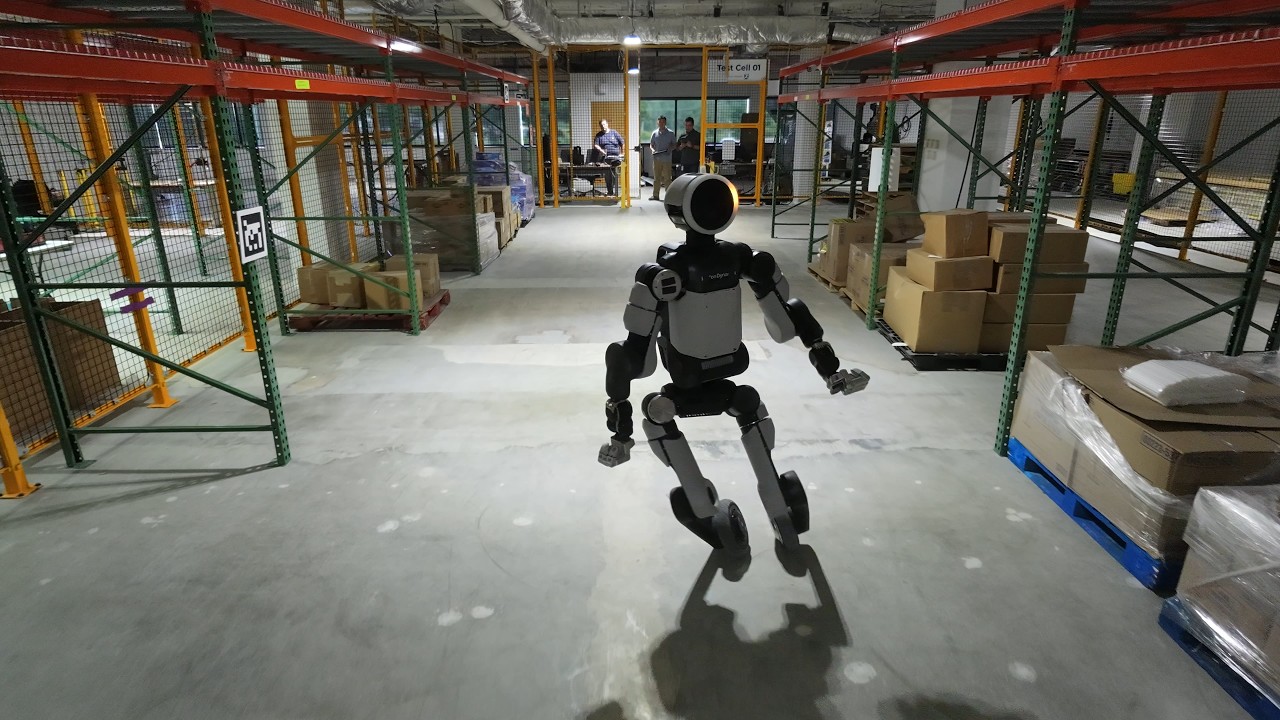
Boston Dynamics puts electric Atlas through a series of walks, runs and crawls.
Explore the sensors, computers, batteries, joints and hands that make a humanoid work.
Digit 4 · Photo by Agility Robotics. Use the list to explore the parts inside.
Hands
The hardware behind the hand matters too. Figure says the forearm was its most common hardware failure point on Figure 02 at BMW. It redesigned the wrist electronics for Figure 03.
Explore the hero-inspired humanoid, the ORCA Hand and an illustrated finger joint. Rotate each model, separate its parts and inspect the build one stage at a time.
Our hero-inspired robot is a Blender concept, with two articulated hands and removable covers. Its mechanics are illustrative, not tested hardware.
Interactive CADReady to explore
0.0 s
Inspect the parts
No matching parts. Try a section or material name.
Feet and soles
Wide foot plates form the base. Separate soles, tread strips and fasteners remain visible when you spread the parts.
All assembly stages (15)
Wide foot plates form the base. Separate soles, tread strips and fasteners remain visible when you spread the parts.
The round drive housings sit between the feet and lower legs. Each has a shaft, bearing rings, end plates and flange bolts.
Two rails flank a controller in each shin. The copper-coloured harness follows the frame and leaves the joint area clear.
A larger rotary joint connects each thigh to its shin. Inside are a stator, rotor carrier, output bearing and an illustrative planetary reduction stage.
The thigh rails carry separate drive modules and wiring. Their outer panels arrive at the end of the build.
The central frame joins both legs. Hip drives sit at either end, below the waist assembly.
Cast crossmembers and side extrusions join the upper body to the waist. The open centre leaves space for power and computing hardware.
Two battery module enclosures sit behind the chassis, with retaining latches, service connectors and separate power leads. No battery capacity or operating range is claimed.
The carrier board has processor packages, finned heat sinks, standoffs, capacitors and latched data connectors. These represent the layout, not a specified computer.
Matching rotary housings sit at the upper corners of the torso. The joints use the same visual language as the hips and knees.
Paired rails connect each shoulder to an elbow drive. Keep the covers hidden to follow the structure into the forearms.
The forearms contain finger-drive cartridges and tendon conduits. A separate wrist housing connects each arm to its hand.
Each hand has four three-segment fingers, a three-link thumb and a separate thumb-opposition pivot. Choose a hand under Inspect area, then move Finger curl to see the individual hinges turn.
Recessed optical barrels, a sensor rail, a controller and heat spreader sit inside the rounded head. The neck mechanism underneath is an imagined construction, not something the image reveals.
Choose an area to inspect the hands, drives or electronics. Spread the parts to see the layers. Turn off Hide body covers to fit the curved housings around the mechanism.
Model, licence and sourcesThe mechanical geometry comes from the same Blender scene as our homepage assembly. The freely rotating model uses volumetric covers in place of the film’s projected artwork. Its mechanisms, wiring and hand motion are illustrative; this is not tested fabrication CAD. Download the editable Blender scene · Download the animation scene · Download the 3D model
 Buy this domain